How to Build a Custom GPT That Improves Workplace Productivity
Artificial Intelligence is rapidly changing how businesses operate. From content creation and reporting to customer communication and workflow automation, AI tools are helping organizations improve efficiency and reduce repetitive work.
However, many professionals still struggle with one major challenge:
How do you make AI consistently useful for real workplace tasks?
This is where Custom GPTs become valuable.
Instead of relying on generic AI conversations, businesses and professionals can now create specialized AI assistants tailored to specific workflows, communication styles, productivity goals, and business needs.
The real opportunity is not simply using AI — it is building structured AI systems that improve workforce capability and operational efficiency.
Why Businesses Are Turning to Custom GPTs
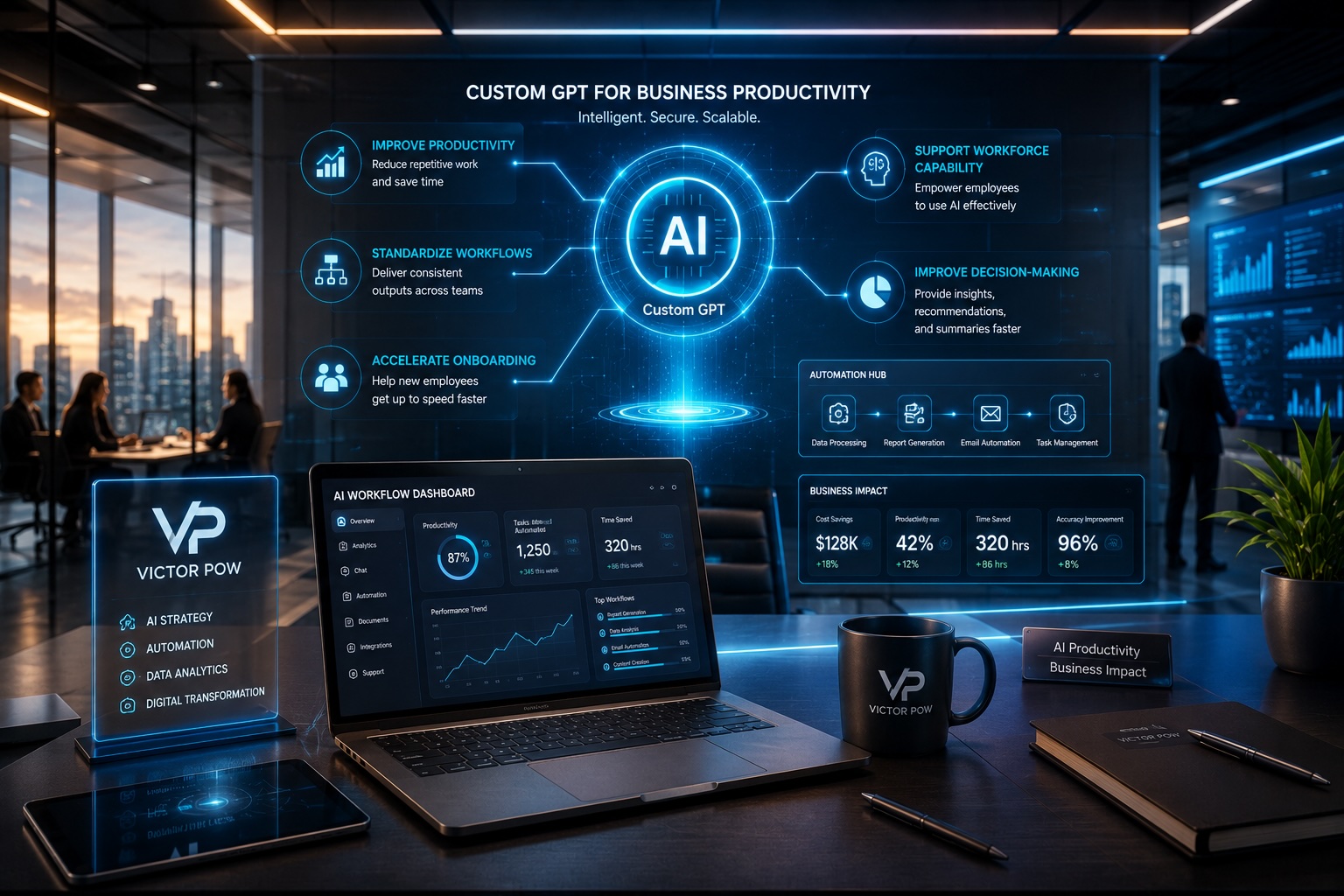
Many organizations face common workplace productivity problems:
- Employees repeatedly asking the same questions
- Inconsistent communication styles
- Time-consuming reporting processes
- Difficulty scaling support and knowledge sharing
- Repetitive administrative work
- Lack of structured AI usage
Generic AI tools often produce inconsistent results because users provide unclear instructions.
Custom GPTs solve this problem by embedding:
- workflows,
- prompting structures,
- communication standards,
- and business logic
into a reusable AI assistant.
What Is a Custom GPT?
A Custom GPT is a personalized AI assistant designed for specific tasks, industries, or business objectives.
Unlike general AI chat tools, a Custom GPT can:
- follow predefined instructions,
- use structured frameworks,
- maintain consistent communication styles,
- and support specific business workflows.
Examples include:
- AI productivity assistants
- customer support GPTs
- reporting assistants
- marketing content GPTs
- AI training assistants
- workflow automation assistants
The Business Value of a Custom GPT
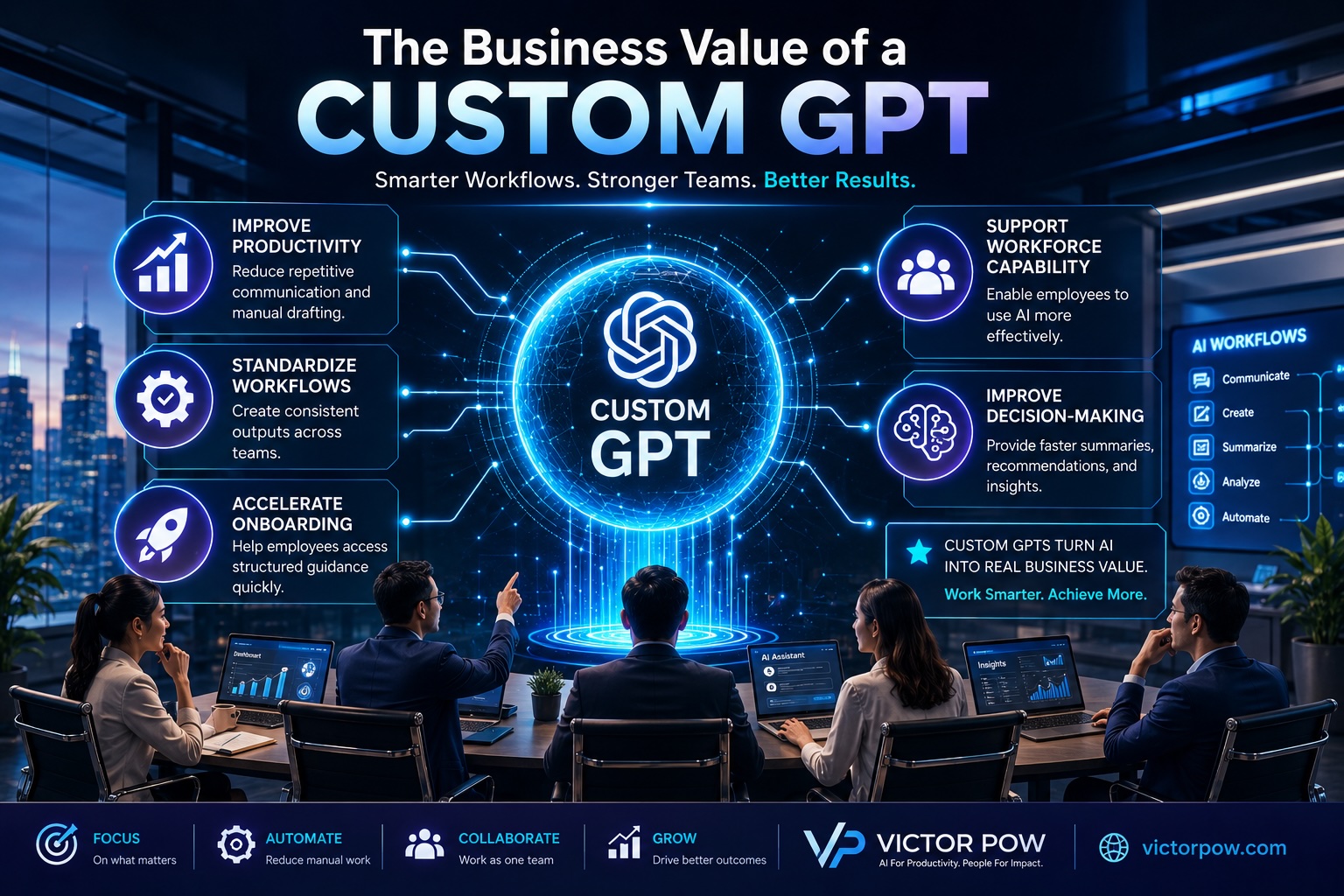
A well-designed Custom GPT can help organizations:
✅ Improve productivity – Reduce repetitive communication and manual drafting.
✅ Standardize workflows – Create consistent outputs across teams.
✅ Accelerate onboarding – Help employees access structured guidance quickly.
✅ Support workforce capability – Enable employees to use AI more effectively.
✅ Improve decision-making – Provide faster summaries, recommendations, and insights.
A Practical Framework for Building a Custom GPT
Instead of building a GPT randomly, organizations should use a structured approach.
🚀 The S.M.A.R.T. GPT Framework
| Stage | Focus |
|---|---|
| S | Solve a real business problem |
| M | Map the workflow |
| A | Align instructions and outputs |
| R | Refine prompting structure |
| T | Test and improve continuously |
Step 1 — Solve a Real Business Problem
Start by identifying repetitive or inefficient workflows.
Examples:
- email drafting,
- meeting summarization,
- reporting,
- content generation,
- customer communication,
- SOP creation.
Step 2 — Map the Workflow
Understand:
- inputs,
- outputs,
- approval flow,
- communication requirements,
- and productivity goals.
This prevents the GPT from becoming too generic.
Step 3 — Align Instructions and Outputs
Define:
- tone,
- structure,
- communication style,
- formatting,
- and business objectives.
Consistency is critical.
Step 4 — Refine the Prompting Structure
This is where structured prompting frameworks become powerful.
One practical example is the:
🚀 T.A.R.G.E.T. Prompting Framework™
| Letter | Meaning |
|---|---|
| T | Task |
| A | Audience |
| R | Role |
| G | Goal |
| E | Expectations |
| T | Tone |
This helps employees communicate with AI more effectively.
Step 5 — Test and Improve Continuously
Custom GPTs should evolve over time.
Review:
- output quality,
- workflow effectiveness,
- employee usability,
- and productivity improvements.
AI implementation is an ongoing optimization process.
Final Thoughts
Custom GPTs are not just AI tools. They are structured productivity systems that help organizations improve workforce capability, communication efficiency, and operational performance.
The organizations that gain the greatest advantage from AI will not necessarily be those with the most advanced technology. They will be the ones that successfully integrate AI into real business workflows and empower employees to use it effectively.
The future of AI in business is not just automation.
It is intelligent workforce augmentation.

✍️ About the Author
Victor Pow is an AI-focused digital marketing strategist and certified educator. He helps professionals and teams use AI tools to improve marketing, productivity, and innovation.
VictorPow.com | LinkedIn